

How AI APIs Are Transforming Creative Workflows for Modern Businesses
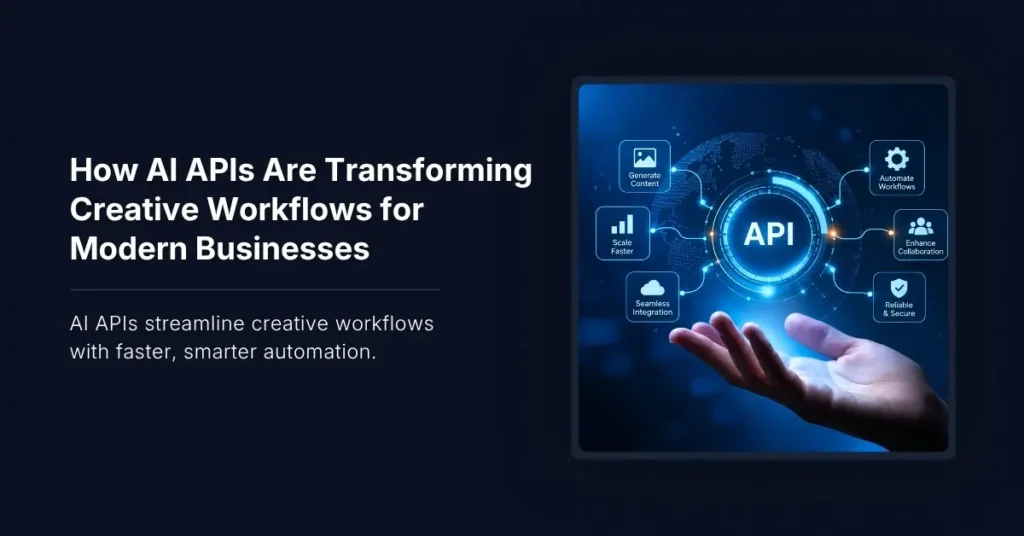
Businesses are creating more digital content than ever, including product images, social media graphics, marketing campaigns, and website visuals. However, producing this content manually can require significant time and resources. AI APIs help businesses simplify these tasks by connecting artificial intelligence capabilities with the software and platforms they already use.
Instead of switching between multiple applications, teams can add AI-powered features to their existing workflows. This makes it easier to create, edit, and manage content while maintaining control over the production process.
Key Takeaway
- AI APIs help businesses integrate AI-powered creative features into their existing software and platforms.
- AI creative tools can support image generation, editing, and content creation, making creative work more efficient.
- Creative workflow automation reduces repetitive tasks and helps teams manage larger volumes of content.
- An AI image generation API can help businesses create visual concepts and product assets, while AI content automation supports faster content preparation.
- The best results come from combining AI capabilities with human creativity, quality checks, and responsible data practices.
Table of Contents
What Are AI APIs?
AI APIs allow businesses to connect creative capabilities with their existing software. Instead of building every feature from scratch, a platform can integrate services such as image generation, background removal, and creative asset access into its own workflow.
For example, businesses can explore the Gemini API reference to understand how AI models can be connected through REST APIs and used for tasks such as content generation and other AI-powered applications.
Instead of developing and maintaining a complete machine-learning model, a company can connect an existing AI service to its website, dashboard, mobile app, or internal system. This makes advanced capabilities more accessible to businesses of different sizes.
Why Businesses Are Adopting AI Creative Tools
Today’s teams manage different types of content, including website copy, social media posts, product listings, advertisements, and email campaigns. Making every asset manually can take a lot of time.
AI creative tools can support these tasks by helping teams:
- Make first drafts of text and visuals.
- Resize content for different platforms.
- Remove backgrounds and improve product images.
- Create different versions for testing and experimentation.
- Maintain a consistent brand style.
These tools don’t eliminate the need for human judgment. Instead, they help creative professionals spend more time on ideas, strategy, editing, and quality control.
How AI-Powered Creative Tools Improve Daily Work
AI-powered creative tools can be connected to existing software through APIs. For example, an e-commerce platform may allow a seller to upload a product photo, generate a clean background, create a promotional image, and prepare a social media caption from one interface.
This reduces the need to move files between different applications. It also creates a more convenient experience for customers and internal teams.
The best results usually come when automation handles repetitive steps and people review the final output. It is still important to have people check for accuracy, originality, brand safety, and accessibility.
The Role of Creative Workflow Automation
Creative workflow automation is when you use software to organize and complete repetitive creative tasks with fewer manual steps. A normal workflow might start when a user uploads an image or enters a product description.
The system can then do several things:
- Receive and validate the input.
- Send the request to an AI service.
- Create or edit the necessary asset.
- Apply the brand rules or formatting.
- Send the result to a human for review.
- The approved content can then be stored or published.
This approach is particularly useful for businesses that produce a lot of content. It can reduce delays, lower repetitive workload, and make production easier to measure.
AI Image Generation API Use Cases
An AI image generation API allows applications to create visuals from written instructions. Depending on the service, businesses may use it for concept images, campaign variations, product scenes, illustrations, or design inspiration.
For example, a furniture retailer could connect an AI image generation API to a product management system. When a new product is added, the system can create lifestyle scene concepts for review. A marketing team could then select, edit, and approve the most suitable version. Businesses can also explore practical discussions about AI image generation APIs on Medium to understand how these integrations are used in real-world projects.
An AI image generation API should support a controlled creative process rather than replace professional design. Businesses need to check image accuracy, licensing terms, brand consistency, and whether the final visual represents the product honestly.
AI Content Automation Beyond Text Generation
AI content automation uses AI services to create, adapt, and distribute content. This can include things like product descriptions, social captions, email drafts, image variations, video scripts, and content summaries.
With AI content automation, a company can turn one approved source into multiple useful formats. For example, a long product description can become a short advertisement, a social caption, and a website summary.
However, AI content automation works best when businesses provide clear instructions, approved brand language, and review standards. If the output isn’t checked, it may contain incorrect claims, repetitive wording, or a tone that doesn’t match the audience.
How AI APIs Connect Different Creative Systems
One major benefit of AI APIs is that they can connect different tools within a single workflow. A content management system, design interface, customer database, and publishing platform can exchange information through API requests.
For example, a website builder could include image editing features directly inside its dashboard. Users wouldn’t have to leave the platform to do basic creative tasks. This type of integration can improve usability and reduce friction.
Platforms like PixAI Creative Suite show how creative features can be part of a digital product experience. For example, businesses can explore PixAI Canvas to see how AI-powered creative capabilities can be integrated into a digital workflow. The goal is not simply to add an AI feature, but to make it useful within the user’s existing workflow.
How AI APIs Create a Connected Creative Workflow
Businesses often use separate tools for product photography, image editing, marketing design, and content preparation. AI APIs can connect these tasks with the software they already use, reducing manual work and repeated file transfers.
A Practical Creative Workflow
Product upload → Image generation → Background removal → Creative editing → Brand review → Publishing
- Product upload: The seller uploads a picture of the product or enters some basic information about it.
- Image generation: An AI image generation API can create backgrounds or lifestyle scenes.
- Background removal: The original background is removed to make the product easier to reuse.
- Creative editing: AI-powered creative tools create different versions for websites, ads, and social media posts.
- Brand review: The team checks that the products are accurate, high-quality, and consistent with the brand.
- Publishing: The approved visual is added to a product listing or marketing workflow.
This simplifies the creative process while allowing human review where needed.
Benefits of AI APIs for Modern Businesses
Businesses can use AI APIs to improve several areas of operations:
- Speed: Teams can complete repetitive tasks more quickly.
- Scalability: Workflows can handle large amounts of content.
- Consistency: Shared prompts, templates, and brand rules can improve content consistency.
- Accessibility: Smaller teams can use advanced creative tools.
- Integration: AI features can be used in existing products.
- Experimentation: Teams can test more content variations.
The benefits depend on how well the technology is implemented. If the integration isn’t designed well, it can lead to extra costs, inconsistent results, or unnecessary complexity.
Important Considerations Before Using AI APIs
Before adopting these tools, businesses should consider more than just content quality. Here are some important things to keep in mind:
Data privacy
Look at how the provider handles uploaded images, prompts, customer information, and stored outputs. Don’t send sensitive data unless the service terms and security controls allow it.
Pricing and usage limits
Check input and output costs, subscription terms, usage limits, and additional charges for high-volume requests. A small test may be affordable, but large-scale usage requires careful budgeting.
Reliability
Look for clear instructions, service status information, error handling, and support options. A creative workflow should have a backup plan for when an API is unavailable.
Human review
Create a set of rules for checking things like whether the information is true, if the images are good quality, if there are any copyright problems, and if the brand is protected. Automation should support responsible publishing, not bypass it.
Accessibility and user experience
Keep the workflow simple and make sure that any content that is created has appropriate text alternatives, is easy to read, and has clear controls.
The Future of AI Creative Workflows
As these technologies become more capable, businesses will likely use them in more connected and specialized workflows. Teams can manage image generation, editing, writing, and publishing through a single creative workspace instead of handling each task separately.
The future will not be defined only by faster technology. It will also depend on better context, stronger quality checks, transparent data practices, and tools that understand business goals.
Conclusion
AI APIs are changing the way modern businesses plan, create, and manage digital content. By connecting AI services with existing software, companies can reduce repetitive work and allow creative teams to focus on strategy and innovation.
The best approach combines AI creative tools and Creative workflow automation with human review and clear business rules. If you implement this model carefully, it can make creative production faster, more flexible, and easier to expand.
FAQs
What are AI APIs used for in creative workflows?
AI APIs connect applications with services for image generation, image editing, writing, content analysis, and other creative tasks.
Can small businesses use these tools?
Yes. Small businesses can use ready-made services to access creative features without developing their own AI models.
What is an AI image generation API?
An AI image generation API allows software to request images from text instructions or other inputs and receive generated visual results.
Is AI content automation reliable?
It can be useful, but every output should be checked for accuracy, originality, brand tone, and compliance before publication.
Do AI tools replace creative professionals?
No. They mainly support repetitive creative and production tasks. Human professionals remain important for ideas, judgment, editing, and final approval.